
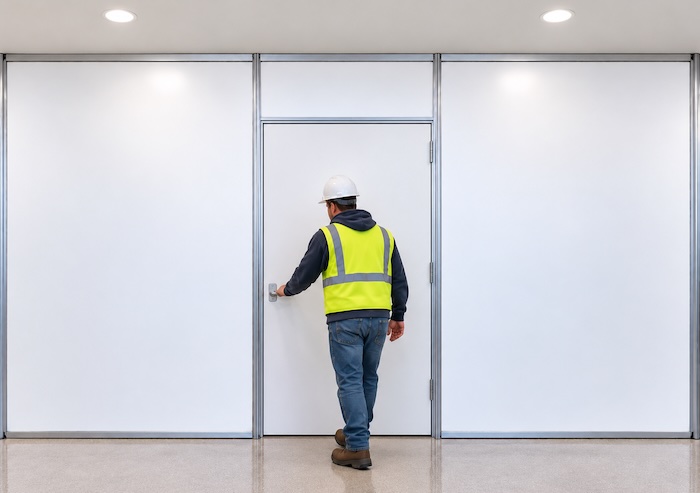
Temporary containment is often associated with major renovations, large construction zones, and long-term projects.
But many of the situations that create dust, debris, noise, and disruption are much smaller.
A ceiling repair, plumbing project, flooring replacement, equipment installation, or electrical upgrade may only affect one room or one section of a building. Even so, that work can still interfere with employees, customers, tenants, patients, students, or visitors nearby.
Edge Guard temporary wall systems can provide a practical way to separate smaller work areas without treating every repair like a major construction project.
Small Projects Can Still Create Big Disruptions
The size of the project does not always determine how disruptive it will be.
A contractor replacing a section of flooring may need to move tools and materials through a busy hallway. A plumber may need to open a wall. An HVAC technician may need access above a ceiling. An equipment replacement may require several days of work in a space that normally remains occupied.
Examples of smaller projects that may benefit from temporary containment include:
- Ceiling repairs
- Plumbing work
- Electrical upgrades
- Flooring replacement
- HVAC maintenance
- Equipment installation
- Drywall repairs
- Painting or finishing work
- Access behind walls or above ceilings
None of these necessarily involves a large renovation, but each can create a work zone that should be separated from the surrounding area.
A Defined Work Area Makes the Project Easier to Manage
Without containment, even a small project can spread into nearby spaces.
Tools may be left in public areas. Materials may need to be stored along hallways. Dust and debris can travel beyond the immediate work area. People may also walk too close to the project simply because there is no clear boundary.
A temporary wall creates a visible separation between the work zone and the rest of the building.
That can help keep the project organized while making it easier for people outside the work area to understand where they should and should not go.
Doors can also be incorporated when workers need regular access to the contained area.
Temporary Containment Can Match the Size of the Job
One advantage of a modular system is that containment does not have to be larger than necessary.
A smaller repair may only require a short wall or compact enclosure. A more involved project may need a longer run of panels or a temporary room.
The containment can be configured around the actual work area rather than forcing the project into a one-size-fits-all solution.
That flexibility can be particularly useful in buildings where space is limited or where normal operations need to continue just a few feet away.
Short Projects Still Benefit From a Professional Appearance
Even a project lasting only a few days can affect how a facility looks.
Plastic sheeting, caution tape, exposed framing, and improvised barriers may make a small repair seem larger and more disruptive than it really is.
A clean temporary wall can help keep the work visually contained as well.
That matters in customer-facing spaces such as offices, hotels, retail stores, healthcare facilities, schools, and public buildings where the surrounding area still needs to look organized and functional.
Containment Should Fit the Project, Not Just the Project Size
Temporary containment is not only for large renovations.
Sometimes the most practical use is a smaller job that needs a clear boundary, controlled access, and a professional separation from the rest of the building.
Edge Guard temporary wall systems can be configured for projects of different sizes, helping contractors and facility managers create a defined work zone without overcomplicating the job.
Whether the project lasts several days or several months, the basic goal is the same: keep the work contained and allow the rest of the facility to keep functioning.
