
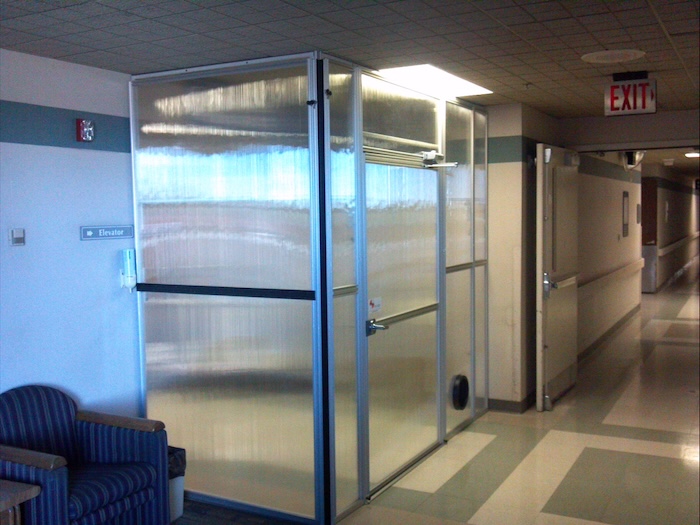
In healthcare, a doorway is not always just a doorway.
Sometimes what happens between one space and the next matters almost as much as what happens inside the room itself.
That is where an anteroom comes in. An anteroom creates a small transition space between a patient room, treatment area, or other controlled environment and the surrounding corridor. Edge Guard temporary anteroom systems can provide that additional layer of separation without requiring a permanent structural change.
More Than an Extra Room
An anteroom may look simple, but its purpose is very specific.
Instead of allowing staff, equipment, supplies, and air movement to pass directly between two environments, the anteroom creates an intermediate space.
That space can help provide:
- A defined transition point for healthcare personnel
- An additional layer of separation from public corridors
- A controlled location for entering and leaving a sensitive area
- Space for certain equipment or supplies needed near the room
- Better organization around restricted entrances
- Additional support for established infection-control procedures
The result is not simply another room. It is a buffer between two different environments.
Managing Movement Through Healthcare Spaces
Hospitals and other healthcare facilities are constantly moving people and equipment.
Nurses enter and leave patient rooms. Carts travel through hallways. Supplies are delivered. Environmental services staff move between areas. Physicians, technicians, and other personnel may need access throughout the day.
When a room requires additional precautions, all of that movement becomes more important.
An anteroom creates a clearly defined transition area before someone moves directly between the controlled room and the corridor. That can make entrances easier to manage and help facilities establish a more deliberate workflow around the space.
Supporting Different Healthcare Environments
Anterooms are often discussed in connection with isolation rooms and infection control, and for good reason.
The CDC notes that an anteroom can be used to help support appropriate air-balance relationships between certain protective environments and surrounding corridors. Its infection-control guidance specifically addresses anteroom use in healthcare environments where controlling airflow is important.
But airflow is only one part of what makes the space useful.
The anteroom also provides a physical and visual transition between environments, helping distinguish the controlled area from the normal traffic patterns of the facility.
Temporary Needs Do Not Always Require Permanent Construction
Healthcare needs can change.
A hospital may need to temporarily adjust how a room or department is used. A facility may need additional separation during maintenance, repairs, construction, seasonal demands, or other short-term circumstances.
Building a permanent anteroom may not make sense when the need itself is temporary.
A modular temporary system provides another option.
The enclosure can be installed where it is needed and removed or reconfigured when conditions change. Doors can be incorporated to provide controlled entry and exit while the surrounding facility continues operating.
Sometimes the Space Between Matters Most
Healthcare facilities put considerable thought into what happens inside patient rooms, treatment areas, laboratories, and other controlled environments.
But the transition between those spaces deserves attention too.
A well-planned anteroom helps create a clear boundary between one environment and another while supporting the movement of people, supplies, and equipment through the facility.
Edge Guard temporary anteroom systems provide a flexible way to create that important transition space when permanent construction is unnecessary or impractical.
Sometimes the most useful space in a healthcare environment is the one between where you are and where you are going.
